 Carroll's 55th Street
 Carroll's 55th Street
02 Estimated Prophet Truckin'.mp3
07 Beat It On Down the Line.mp3
08 Monkey and the Engineer.mp3
11 One More Saturday Night.mp3
14 Lost Sailor Saint of Circumstance.mp3
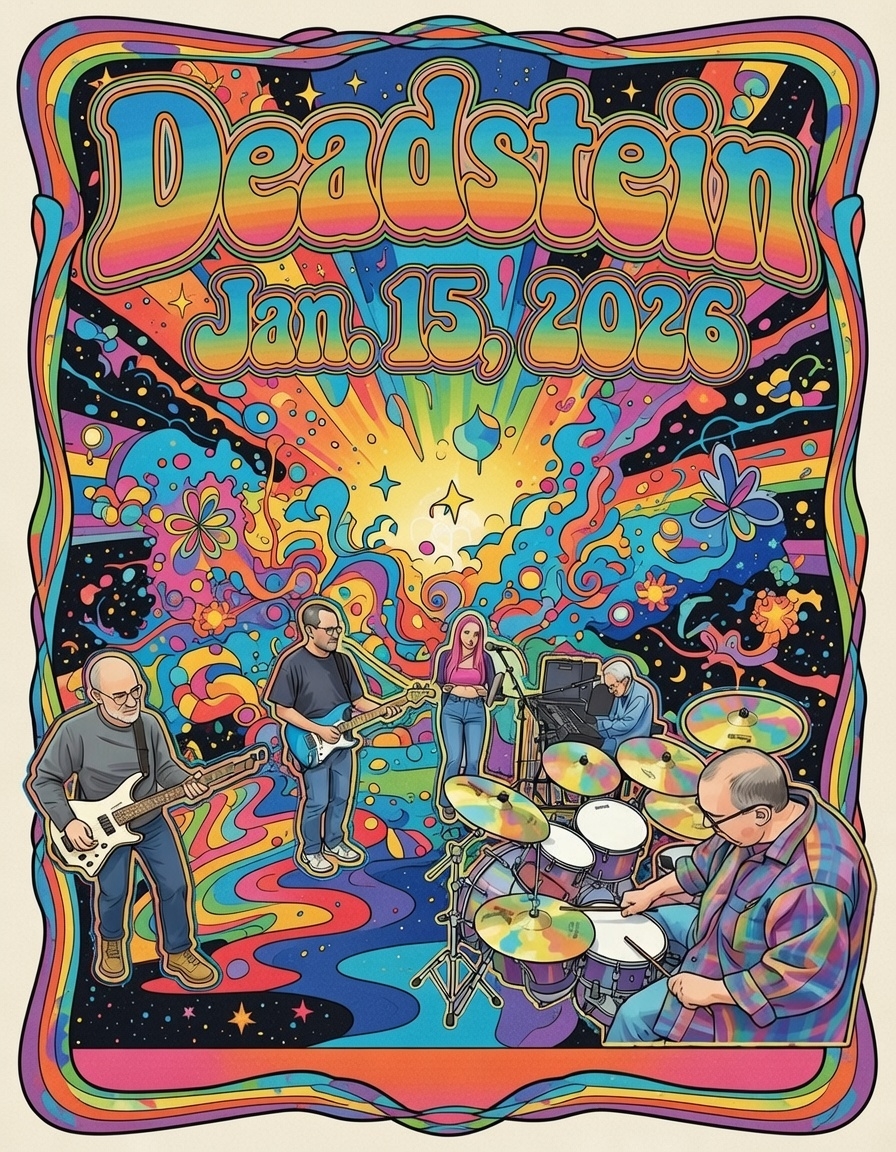
Greetings, Deadsteinheads. In the shadow of profound loss, Deadstein gathered on January 15, 2026, at Carroll's 55th Street studio in New York City for what would become one of our most emotional sessions yet. It was different, marked by sorrow and reflection. Just days earlier, on January 10, 2026, the world learned of the passing of Bob Weir at the age of 78. A founding member of the Grateful Dead, Weir was more than a musician; he was a rhythmic force, a lyrical poet, and a kind-hearted soul whose love for playing in the band inspired generations. For Deadstein, and especially for Larry Gindoff, Weir's influence ran deep-shaping guitar techniques, vocal stylings, and the sheer joy of communal music-making. This jam, dedicated entirely to Weir's songs and covers he championed, was our way of saying farewell while keeping his music alive. As Weir himself sang in "Truckin'," "What a long, strange trip it's been"-and for us, the trip continues, hoping the music never stops.
The evening's lineup reflected Deadstein's resilient core, bolstered by the return of a new voice that added poignant layers to our tribute. Larry Gindoff anchored the session on guitar and vocals, his playing infused with Weir's signature rhythm-those choppy, jazz-influenced chords that drove the Dead's engine. Larry, in particular, has long cited Weir as a primary influence, emulating his feral radiance on stage and his dedication to the band's collective groove. Kevin Forrester held down the bass with Phil Lesh-like precision, providing the thunderous foundation that allowed Weir's songs to breathe and evolve. Rich Brotpen commanded the keyboards and shared vocals, evoking the swirling Hammond tones that complemented Weir's style in the Dead's heyday. On drums, Lee Ganbarg brought a Mickey Hart and Billy Kreutzmann-inspired pulse, layering percussion that captured the exploratory essence of Weir's compositions.
For the second week in a row, Pink Alisa (or simply Pink) joined us for the first set, her vocals adding spot-on harmonies reminiscent of Donna Jean Godchaux's soaring contributions and Brent Mydland's soulful backups. Pink's presence was especially fitting for this tribute, as her growing familiarity with our songbook-now over 20 tunes strong-allowed her to weave seamlessly into Weir's folk-rock anthems. The vibe in the room was a delicate balance: somber, with moments of quiet reflection on Weir's passing, yet celebratory, as we channeled his unyielding passion for live performance. Stories flowed-memories of Dead shows, Weir's ventures, and how his ethos of "just playing in the band" has kept Deadstein going for 35 years. It was a night where music healed, echoing Weir's belief that the band was a team, a family, forever jamming onward.
To fully appreciate this jam, we must delve into Bob Weir's extraordinary life-a journey that mirrored the Grateful Dead's own long, strange trip. Born Robert Hall Weir on October 16, 1947, in San Francisco, Weir was adopted as an infant and grew up in Atherton, California. Dyslexia made traditional schooling a challenge, leading him to boarding schools where he discovered his love for music. At 15, on New Year's Eve 1963, Weir wandered into Dana Morgan's Music Store and met a young Jerry Garcia, who was giving banjo lessons. Their instant connection-fueled by shared passions for folk, bluegrass, and rock-sparked the formation of Mother McCree's Uptown Jug Champions, which evolved into the Warlocks and, by 1965, the Grateful Dead.
Weir-s role in the Dead was pivotal. As rhythm guitarist, he provided the "feral radiance" that drove the band's improvisational magic, blending jazz chords, country twang, and rock energy. He sang lead on many of the band's rock & roll and country-western tunes, his voice a gritty counterpoint to Garcia's ethereal tones. Weir co-wrote classics like "Sugar Magnolia," "Playing in the Band," "Truckin'," "The Other One," "Estimated Prophet," "Jack Straw," "Cassidy," "Looks Like Rain," "One More Saturday Night," and the epic "Weather Report Suite." These songs weren't just hits; they encapsulated Weir's worldview-adventurous, philosophical, and deeply human. In "Playing in the Band," he pondered, "Some folks trust to reason, others trust to might / I don't trust to nothing, but I know it come out right," reflecting his trust in the band's collective intuition.
Weir's influence extended beyond songwriting. His tireless dedication to live performance-over 2,300 shows with the Dead-made him the custodian of their legacy after Garcia's death in 1995. He formed RatDog, toured with the Other Ones, Further, and Dead & Company (with John Mayer), ensuring the music never stopped. Collaborations with everyone from Bob Dylan to the National Symphony Orchestra showcased his versatility. Weir-s kindness shone through in his environmental activism, support for HeadCount (voter registration), and his role as a mentor. As Phil Lesh once said, "He was my first friend in the Grateful Dead. We lived together, played together, and made music together that ended up changing the world."
For Deadstein, Weir's impact is woven into our DNA. From our first jam in 1990, his songs have been staples-analysis of our songbook reveals over 50 tunes associated with Weir, played hundreds of times across 1,536 documented jams. Larry Gindoff, in particular, draws from Weir's guitar style: those inverted chords, syncopated rhythms, and the ability to "play in the band" without ego. Larry often recounts how Weir's approach-blending McCoy Tyner jazz influences with country picking-inspired his own playing during Deadstein's early days at Perry Street. Vocally, Weir's raw, narrative delivery shaped Larry's interpretations, turning songs like "Cassidy" into personal stories. Beyond technique, Weir's humanity-his love for the band as a "team" and his perseverance through the Dead's ups and downs-mirrors Deadstein's journey. We've weathered venue changes (from Ganesvoort Street to Carroll's), lineup shifts, and life events, always returning to jam because, as Weir embodied, the music is a lifeline.
Stories abound in Deadstein lore tying back to Weir. In one 1995 jam, shortly after Garcia's passing, we dove into a marathon "Playing in the Band," channeling Weir's spirit of exploration as the jam stretched into uncharted territory-much like the Dead's 1972 versions. Another time, during a 2004 session at Smash Studios, a fierce "The Other One" evoked Weir's cosmic lyrics: "Spanish lady comes to me, she lays on me this rose / It rainbow spirals round and round, it trembles and explodes." These moments remind us how Weir's songs invite improvisation, turning covers into our own strange trips. Even in covers Weir introduced to Deadheads-like Chuck Berry's "Around and Around" or Bob Dylan's "Queen Jane Approximately"-his interpretations added that signature Dead twist, influencing our non-Dead explorations.
In honor of Weir, our setlist was exclusively his compositions and covers he made iconic, a deep dive into the music he left us. We opened with "Feel Like a Stranger," a Weir/John Barlow collaboration from 1980's Go to Heaven album, its funky groove and lyrics about disconnection-"Inside you're burnin', I can see clear through / Your eyes in this light are glowing blue"-mirroring Weir's own journey as a young outsider finding his place in the Dead. Larry's guitar chopped through the rhythms, evoking Weir's jazz-infused style, while Pink's harmonies added a Donna-like lift, setting a reflective yet energetic tone for the tribute.
The segue between "Estimated Prophet > Truckin'" was seamless, highlighting Weir's prophetic songwriting. "Estimated Prophet," co-written with Barlow in 1977 for Terrapin Station, features that signature 7/4 time signature Weir loved, drawing from his McCoy Tyner influences: "My time coming, any day, don't worry about me, no." It flowed into "Truckin'," a 1970 anthem co-penned with Garcia, Lesh, and Hunter, autobiographical of the Dead's road life-"Arrows of neon and flashing marquees out on Main Street"-a staple Weir belted with grit. Kevin's bass bombs echoed Phil Lesh's style, propelling the jam as stories of Weir's bust in New Orleans (inspiring the lyrics) were shared between verses.
"Looks Like Rain," another Weir/Barlow gem from 1970's Ace (Weir's solo debut), brought emotional depth with its melancholic plea: "I woke today, and felt your side of bed / The covers were still warm where you'd been layin'." Pink's vocals soared here, capturing the vulnerability Weir infused into ballads, a nod to his personal life amid the Dead's chaos.
Covers Weir championed followed, starting with "Me and Bobby McGee," Kris Kristofferson's hit that Weir sang as part of the Dead's repertoire from 1971, reflecting his folk roots: "Freedom's just another word for nothin' left to lose." "Mexicali Blues," a Weir country-rocker from 1972's Ace (Weir's solo album), evoked border-town tales-"She said her name was Billie Jean and she was fresh in town"-with Larry channeling Weir's twangy guitar.
"Playin' in the Band," the 1971 Weir/Hunter/Hart epic, stretched into a long exploration, embodying Weir's philosophy: "Daybreak on the land."
"Beat It On Down the Line," a Jesse Fuller cover Weir sang since the Dead's early days, its upbeat blues-"Happy home, happy home, everybody needs a happy home"-recalling Weir's bluegrass beginnings. "Monkey and the Engineer," another Fuller tune from acoustic sets, told a whimsical train story, highlighting Weir's love for folk narratives.
"Good Lovin'," the Young Rascals cover that Weir took over after Pigpen's passing in 1973, rocked hard: "Doctor, doctor, mister M.D. / Can you tell me what's ailin' me?" It captured Weir's transition into a more prominent frontman role.
"Dark Hollow," a traditional folk song Weir performed acoustically, offered a haunting interlude-"I'd rather be in some dark hollow where the sun don't ever shine"-tying back to his early jug band days with Garcia.
"One More Saturday Night," Weir's 1971 solo-penned rocker, revved the energy: "God way up in heaven, for whatever it was worth / Thought he'd have a big old party, thought he'd call it planet Earth." It was a staple for encores, reflecting Weir's party-loving side.
"Samson and Delilah," a traditional blues revival tune Weir sang from 1976 onward, thundered with biblical power: "If I had my way, I would tear this old building down," evoking Weir's gravelly delivery. Pink bowed out after this first-set closer, her harmonies a fitting tribute to Weir's collaborative spirit.
The second set kicked off with "Hell in a Bucket," a 1987 Weir/Barlow/Brent Mydland track, brought '80s flair-"At least I'm enjoying the ride"-nodding to Weir's later collaborations and resilience through the Dead's evolving eras.
The pairing of "Lost Sailor > Saint of Circumstance," both Weir/Barlow from 1980, painted seafaring metaphors: "Compass card is spinning, helm is swingin' to and fro" into "This must be heaven." It showcased Weir's thematic depth, inspired by his love of sailing.
"Black-Throated Wind," a 1972 Weir/Barlow ballad, reflected introspection-"Bringing me down, I'm running aground"-a favorite for its emotional rawness, as noted in Rolling Stone's list of Weir's best.
"I Need a Miracle > When I Paint My Masterpiece" segued powerfully; the former a Weir/Barlow plea from 1978-"I need a miracle every day"-into Dylan's cover that Weir made his own, singing of artistic struggle.
"Big River," Johnny Cash's cover Weir belted since 1971, rolled with country vigor-honoring Weir's roots influences.
We closed with "The Music Never Stopped," Weir/Barlow's 1975 ode to perseverance: "The music never stopped." It was the perfect farewell, encapsulating Weir's wish that the jam goes on eternally.
This jam was more than a setlist; it was therapy. Weir's passing at 78, after a life of over 60 years in music, left a void, but his legacy fills it. From teen founder to elder statesman, Weir's path-through acid tests, fame, loss, and revival-inspired Deadstein's free-spirited approach. We've played his songs in basements, bars, and backyards hoping to capture that "team" vibe he cherished. Larry often says Weir taught him to "trust to might," letting jams unfold organically, as in our 2025 double-drumming sessions.
Weir's ethos, kindness-mentoring young musicians, advocating for causes-echoes in our community. As the Guardian noted, Weir was the "chief custodian" of the Dead's influence, solidifying it through collaborations that kept the flame alive.
Stories from Weir's life pepper our reflections: his dyslexia-fueled creativity, meeting Garcia, surviving the Dead's chaos, and post-1995 reinventions. In Deadstein, these translate to perseverance-jamming through pandemics, moves, and now loss. His songs remind us: "Lately it occurs to me / What a long strange trip it's been."
Heartfelt thanks to Pink Alisa for her harmonies, Larry, Kevin, Rich, and Lee for their passion. To Bob Weir: thank you for the music, the lessons, the life. Deadstein endures because of legends like you.
As the archivist and publicist for Deadstein, it's my honor to craft this original song as a heartfelt tribute to Bob Weir. Drawing from the philosophical, adventurous spirit of Weir's collaborations with John Perry Barlow-think the cosmic introspection of "Estimated Prophet" or the narrative drive of "Playing in the Band"-I've composed "Eternal Rhythm." This tune reflects on Weir's extraordinary life, his passing on January 10, 2026, at age 78, and the legacy he leaves to bands like Deadstein. We've played countless Weir tunes over our 1,500+ jams, from "Truckin'" to "The Music Never Stopped," and his rhythm guitar ferocity, gritty vocals, and team-player ethos have shaped our sound. Now, we carry the torch, ensuring the music never stops.
The song features four verses chronicling Weir's journey-from his folk roots to his custodial role in the Dead's legacy. The repeatable chorus has a hooky, anthemic feel: "The rhythm rolls on, never gonna fade." It's designed for communal sing-alongs, much like Weir's crowd-pleasers. The bridge shifts for a melodic guitar lead (inspired by Weir's jazz-infused chops), building tension before resolving. Finally, it closes with an extended modal jam in A Mixolydian, perfect for Deadstein's improvisational explorations-think spiraling leads over a droning A chord, echoing "Playing in the Band" extensions.
Chord structure is provided in a simple, Weir-style progression: bluesy rock with country twang, in the key of A major for that bright, driving energy. Tempos around 120 BPM, with verses in a steady 4/4 and the bridge dipping into a 7/4 nod to "Estimated." Imagine Larry Gindoff channeling Weir's inverted chords on guitar, Kevin Forrester dropping Phil'like bass bombs, Rich Brotpen swirling on keys, and Lee Ganbarg locking in the groove.
Key: A Major
Overall Feel: Mid-tempo rock with folk undertones, building to psychedelic jam. Use open chords for acoustic vibe, add distortion for electric leads. Weir's influence: Syncopated strums in verses, jazzy extensions in bridge.
Verse 1 Chord Progression: A - D - E - A (repeat for each line, strum pattern: down-up-down with emphasis on 2 and 4)
Born under Bay Area skies,
a kid with a restless soul,
Dyslexic dreams and guitar strings,
makin' the Warlocks whole.
From jug bands to acid tests,
he found his feral light,
Rhythm king in the Dead's wild ride,
playin' through the night.
Chorus Chord Progression: A - E - D - A (big, anthemic strums; repeat twice per chorus for build)
The rhythm rolls on,never gonna fade,
Bob's songs echo in the shade.
From the stage to the stars, the band's still playin',
Eternal rhythm, keep on swayin'!
Verse 2 Chord Progression: A - D - E - A
Truckin' down the highways,
busts and neon signs,
With Jerry and the brothers,
crossin' all the lines.
Looks like rain but
the sun breaks through, in every twisted tale,
He painted masterpieces,
on winds that never fail.
Chorus: (Repeat as above)
The rhythm rolls on, never gonna fade,
Bob's songs echo in the shade.
From the stage to the stars, the band's still playin'',
Eternal rhythm, keep on swayin'!
Verse 3 Chord Progression: A - D - E - A
After the captain fell,
he carried the flame so bright,
RatDog roamin',
Furthur on, into the endless night.
Mentor to the young ones,
voter drives and green,
A sailor's heart on open seas,
kind as he's ever been.
Chorus: (Repeat)
The rhythm rolls on, never gonna fade,
Bob's songs echo in the shade.
From the stage to the stars, the band's still playin',
Eternal rhythm, keep on swayin'!
Verse 4 Chord Progression: A - D - E - A (slow build, add tension with suspended chords like Asus4)
Now the prophet's voice is silent,
but the other one's still here,
Legacy in every chord,
crystal clear.
Bands like Deadstein pick it up,
in studios and streets,
Playin' in the band forever,
where the strange trips meet.
Chorus: (Repeat, with vocal harmonies building)
The rhythm rolls on, never gonna fade,
Bob's songs echo in the shade.
From the stage to the stars, the band's still playin',
Eternal rhythm, keep on swayin'!
Bridge Chord Progression: F#m - E - D - A (shift to minor for introspection; 7/4 time for Weir flair: count 1-2-3-4-5-6-7)
Time comin' any day,
don't worry 'bout the end,
The music's in the ether,
round the bend.
(Guitar Lead: Melodic solo over F#m pentatonic scale, building from slow bends to fast runs, ~32 bars. Larry channels Weir's McCoy Tyner jazz licks-chromatic passes, hammer-ons. Fade back into A major.)
Extended Modal Jam: A Mixolydian mode (A - G - D - A vamp, or drone on A with improvisations). Start with rhythm guitar chopping Weir-style inversions, bass walking in Mixolydian scale (A-B-C#-D-E-F#-G). Keys add swirling organ fills. Drums build polyrhythms à la Hart/Kreutzmann. Guitar leads explore: bendy blues in verses 1-2 feel, spacey echoes for cosmic section, resolve with group crescendos. Jam for 5-10 minutes, fading out on sustained A chord-symbolizing the eternal legacy. End with a final chorus tag: "The rhythm rolls on..."
This song captures Weir's essence: his adventurous life from San Francisco streets to global stages, his kindness in activism and mentorship, and his philosophical lyrics that ponder fate and freedom. For Deadstein, it's a way to honor how Weir's "team" mentality-seen in over 2,300 Dead shows and post-1995 projects like Dead & Company-mirrors our weekly jams at Carroll's or past spots like Smash Studios. We've analyzed his influence in our history: Weir tunes make up a huge chunk of our GD songbook, inspiring Larry's raw vocals and our communal grooves. Play this at your next jam, Deadsteinheads -upload your versions to our site, and let's keep the eternal rhythm alive.
Deadstein: Keeping the Dead Alive Since 1990
Freak Out!